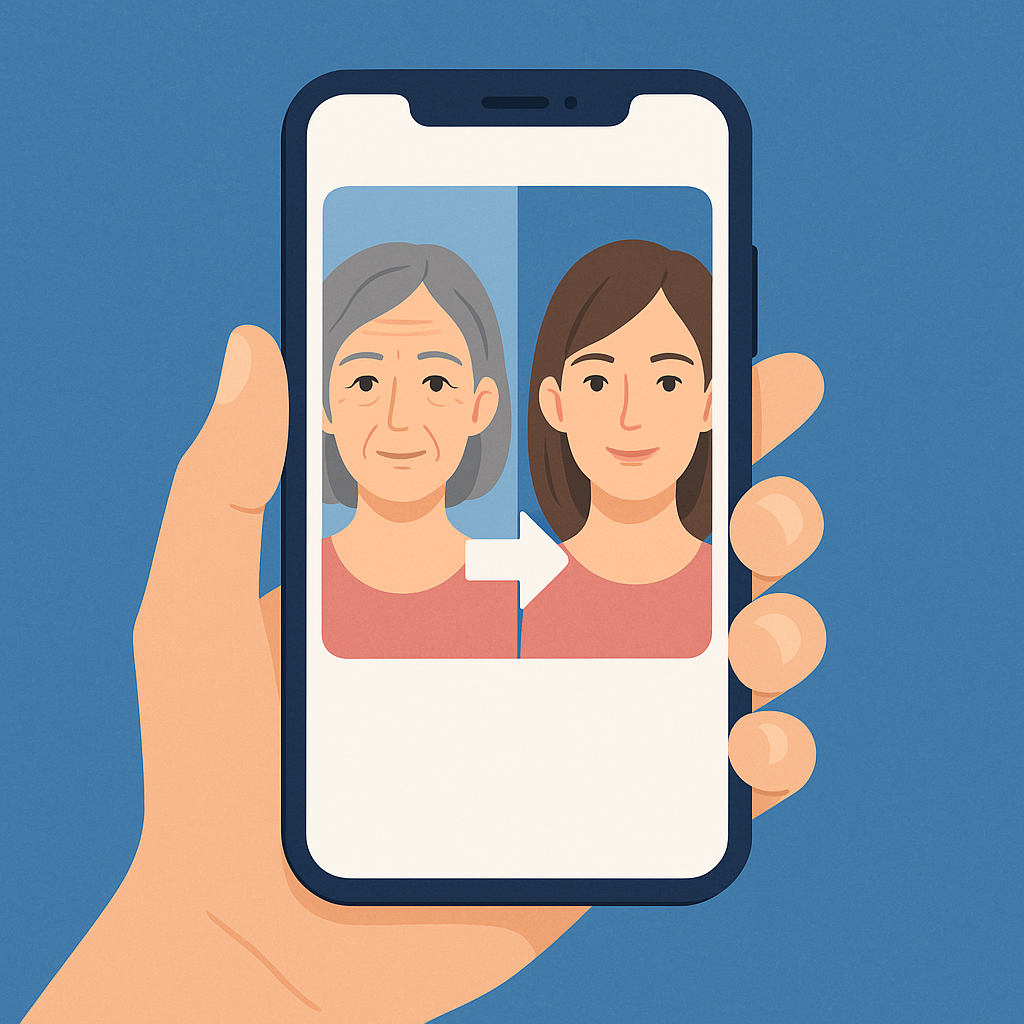
A facial rejuvenation app doesn't change your skin: it changes your photo. Artificial intelligence maps your face, smooths wrinkles, and adjusts texture and contour to simulate a younger version of the same image. The effect exists on the screen, and only on the screen.
This page lists five apps that do this type of editing, what each one offers in the free version, where the subscription starts, and what to check in the privacy policy before sending a selfie.
How Does a Facial Rejuvenation App Work?
A common question among users is: Do rejuvenation apps really work?
First of all, it's important to understand that these apps use artificial intelligence and realistic filters to simulate a younger-looking face. Using facial mapping technology, the app recognizes key areas like the eyes, forehead, mouth, and cheekbones. It then smooths expression lines, eliminates wrinkles, and enhances skin texture.
Additionally, many of these apps offer additional tools like skin tone adjustments, facial brightness, dark circle correction, and even hairstyle changes. This makes the transformation experience even more complete.
5 Best Facial Rejuvenation Apps to Download Now
Below, you'll discover the 5 most popular apps that offer facial rejuvenation. All are available for download on PlayStore, and many of them can be used for free.
FaceApp
FaceApp is one of the most well-known applications in the world when it comes to transform your face with an app. That's because it uses neural networks to apply ultra-realistic effects with a simple touch.
First, the app stands out for its facial rejuvenation feature, which smooths skin, lifts eyelids, and restores youthful smiles. Additionally, FaceApp lets you apply virtual makeup, change your hairstyle, and even adjust photo lighting.
Finally, its distinguishing feature lies in the accuracy of its results. With a single click, you can compare your current version with a rejuvenated one, making the experience both fun and exciting. Download now and see for yourself!

YouCam Makeup
Although it is known as a virtual makeup app, YouCam Makeup has impressive features. rejuvenation effect. So don't be fooled by the name: this app is a powerful tool for looking younger.
It also offers skin diagnostics and personalized recommendations based on your selfie. AI detects blemishes, fine lines, and oiliness, automatically suggesting changes to instant youthful skin.
So, if you're looking for an app that combines digital beauty with facial care, this is a great choice. Available for free download.

AirBrush
AirBrush is ideal for those who want fast, natural results. Its main features include teeth whitening, imperfection removal, and, of course, facial rejuvenation.
The interface is simple and intuitive, ideal for those who want to edit their photos without complications. One of AirBrush's highlights is the "Real Beauty" mode, which enhances your appearance without overdoing it.
So, if your goal is to look younger without losing your naturalness, this app deserves your attention. Downloading it for free and trying it out is a great start!

Perfect365
Perfect365 stands out for its beauty studio-worthy features. With over 100 million downloads, it's widely used by makeup artists and content creators.
Among its functions, we highlight the young face filter that applies intelligent smoothing, eliminates signs of aging, and brightens your skin. Plus, you can try out complete makeup looks, further enhancing the transformation.
Above all, it is a fun and practical tool for those looking to facial transformation with app. Download it now and try it out!
Facelab
Facelab has been gaining ground among facial editing fans for its practical and straightforward approach. It combines AI facial editing, beauty filters and automatic adjustments to deliver stunning results.
A strong point is its "Before and After" feature, which allows you to clearly see the difference in skin, wrinkles, and texture. And as if that weren't enough, the app integrates with social media, making it easy to share transformations.
It is certainly one of the most complete applications available today, and the best: you can download it for free directly from the PlayStore.

Extra Features Worthwhile
In addition to traditional features, many apps offer additional features that further enhance the experience. For example:
- Skin age diagnosis: Based on AI, it calculates the age of your skin by comparing it to real patterns.
- Personalized facial care suggestions: Indicates which areas need more attention and how to improve their appearance.
- Real-time editing: Ideal for stories and live videos, you can apply filters while recording.
- Professional mode for selfies: Adjust lighting, contrast and saturation with millimeter precision.
In this way, the apps not only transform the look, but also educate the user on how to improve their personal aesthetics.
What does "skin smoothing" do to image texture?
The effect that most rejuvenates a photo is also the simplest to explain. Smoothing the skin is, technically, erasing small variations in tone within an area and keeping only the large variations. The program separates the image into two levels: the fine detail, which is pores, hair, texture, and delicate lines, and the overall shape, which is the contour of the face, the shadow of the nose, the volume of the cheek. Then it reduces the first level and restores the second on top.
The result is immediate: the skin becomes even and the appearance of age is significantly reduced, because much of what we perceive as "age" in a photo is actually surface irregularities. The cost is also immediate: along with the irregularities, the pores disappear, and it's the pores that make the skin look like skin. If you go too far, the face takes on that smooth, lifeless appearance that anyone can identify instantly, even without being able to explain why.
The best apps apply this reduction selectively: heavily on the forehead and cheeks, lightly around the eyes and mouth, and not at all on eyelashes, eyebrows, and hair. Simpler apps apply it evenly, and that's when eyebrows become blotchy and hair loses its outer edges.
Digital retouching doesn't treat skin.
It seems obvious when stated like that, but the language used in these apps constantly confuses the two. A feature that displays "skin analysis," points out blemishes on the screen, and shows an age score is performing image statistics: it measures local contrast, tone uniformity, and brightness, and compares them to reference ranges. This is not an examination, it is not a diagnosis, and it does not replace consultation with a healthcare professional.
The distinction is important because the score changes depending on the ambient light. The same person photographed near a window and then under a bathroom light receives different scores, even though nothing has happened to their skin. If the number changes with the light, it's describing the photo, not you.
Similarly, removing dark circles, blemishes, or marks from an image doesn't change anything beyond the image itself. The app delivers an edited version of the file; it doesn't act on the body, doesn't prevent anything, and shouldn't guide treatment decisions. When a feature like this combines "analysis" with selling a product, you've left the realm of photo editing and entered the realm of advertising.
The beauty mode that your phone already has built-in.
Many people install an app to achieve what the device itself already does. On both Android and iPhone, the native camera usually offers some degree of skin smoothing in portrait mode or selfies, and it's almost always possible to adjust the intensity—including turning it off for those who prefer realistic texture.
The native photo app also offers essential retouching tools: cropping, exposure adjustment, shadows, highlights, contrast, saturation, and a small object removal tool. For brightening the face, opening up shadows under the eyes, and balancing color, this solves most problems.
And there's an important practical advantage: the edits made by the native app are usually reversible. The system keeps the original version hidden, and at any time you can reopen the photo and return to the initial state. A third-party editor that exports a new file doesn't have this link — if you saved over and deleted the original, that's it.
Signs that the touch-up went too far.
These are brands that are easy to recognize once someone has pointed them out:
- Luminous outline around the headThis appears when the smoothing or brightening tool bleeds into the background.
- warped bottomThe doorway, tile, or frame that should be straight appears curved near the face. This is due to the warp mesh pulling on neighboring pixels.
- Poreless and shine-free skin: surface that is too uniform, with the appearance of synthetic material.
- Eyes and teeth that are too white.They lose the slightly grayish tone that exists in any real photo.
- Hair with a scalloped edgeFine threads disappear, and the silhouette takes on a hard outline.
- Ears and neck out of syncThe face was retouched, but the rest wasn't, creating two textures in the same photo.
A quick test: view the image in full screen and then compare it to the original. If the discomfort appears in this comparison, it will also appear to whoever receives the photo.
What makes a photo look younger without any filter?
- Front and diffused lightNear a window, out of direct sunlight. Frontal light fills in the shadows that define the eye area.
- Avoid the ceiling light.Lighting from above creates shadows under the eyes, nose, and chin, exactly where nobody wants shadows.
- Camera at eye level or slightly above.From bottom to top, the photo emphasizes the chin and neck.
- A step back with a slight zoom.: reduces the widening of central features caused by proximity.
- Clean background, darker than youIt separates the face and prevents the viewer's eye from competing for attention.
- Rear camera whenever possible.It usually has a better sensor than the front camera, and more starting information means less need for correction.
- Touch exposure adjustmentHold your face close to the screen and adjust the brightness before shooting. Correcting it in the moment yields better results than correcting it later.
Common questions
Why does the photo look good on a cell phone screen but strange on a computer screen?
Because the small screen hides flaws. Excessive smoothing, poorly cut edges, and loss of texture only become evident at a larger size. If the photo is intended for professional use, evaluate the result on a large screen before publishing.
Does applying the effect twice improve the result?
It gets worse. Each pass erases more fine detail, and what's gone doesn't come back in the second round. The solution is to apply it once, with moderate intensity, to the original file—never to a version that has already been edited and exported.
Is there a difference between rejuvenating and simply improving a photo?
It exists, and it's a big one. Improving means correcting what the camera got wrong: exposure, color, framing. Rejuvenating means altering the person's appearance. The first operation keeps the photo faithful; the second creates a new image, which may or may not be what you want to convey.
Does a filter on video work the same way as a filter on photo?
The principle is the same, but in video the processing happens dozens of times per second. Therefore, the effect is usually weaker, the device overheats, and the battery drains quickly. It's also common to see the filter "escape" when you turn your face to the side.
Is it okay to use a retouched photo on a resume or professional profile?
Adjusting light and color is fine. Altering features is not: whoever meets you in person will notice the difference, and the effect is the opposite of what you intended. A well-lit and sharp photo conveys more care than a heavily edited one.
Conclusion
In short, the applications of facial rejuvenation are powerful tools that allow you to explore younger versions of yourself. Through intelligent features and well-designed filters, you can soften features, enhance skin tone, and even change your hairstyle with stunning realism.
Whether for curiosity, self-esteem, or social networking, these apps are here to stay. And the best part: many of them offer download for free, with complete and accessible versions. So don't waste time! Download app Rejuvenation can be the first step to reconnecting with your younger, more confident self.
Remember: youth is a state of mind, but with cutting-edge technology, it can also be a tap on a screen.