
Is your phone slow or running low on storage space? The Cleaner It's one of the world's most popular apps for freeing up space and improving device performance. Developed by Piriform (part of Avast), it's available for Android and can be downloaded below:

Next, you'll understand everything CCleaner does, how to use it correctly, and whether it's really worth installing this app on your phone.
What does CCleaner do?
CCleaner is a cleaning app that helps you remove unnecessary files from your phone, such as app cache, temporary files, empty folders, duplicate files, and uninstallation remnants. It also offers features to optimize RAM, monitor CPU usage, and even remove resource-intensive apps.
The idea is simple: perform a complete scan of the device and show everything that can be safely deleted, freeing up space and making the phone faster.
Main features
See the main features available in CCleaner:
- Smart cleaning: It automatically identifies junk and temporary files.
- Application administrator: It shows which apps take up the most space or consume the most battery.
- System monitoring: Monitors memory usage, CPU usage, and device temperature in real time.
- One-touch optimization: Cleans and frees up space quickly with just one button.
- Storage analysis: It shows you what takes up the most space on your phone in easy-to-understand graphs.
Compatible with Android and iOS.
CCleaner is available for Android and can be downloaded directly from the Google Play Store.
The iOS version not availableThis is because Apple's system does not allow this type of access to internal files. For iPhone users, it is recommended to use other applications specifically designed for Apple's operating system.
How to use CCleaner on your mobile phone (step by step)
- Download the app from the Google Play Store and install it normally.
- Open CCleaner and grant the necessary permissions to access the storage.
- Tap on "Start analysis" so that the app can scan your phone.
- After the analysis, a list of files that can be deleted will be displayed.
- You can review what will be deleted or simply tap on it. "Finish cleaning".
- You can also access the tab "Applications" to uninstall those that you don't use.
- Use the button Booster Device to clear RAM and increase performance.
Advantages and disadvantages
Advantages:
- Simple and easy-to-use interface;
- Quickly free up space;
- One-touch performance optimization;
- Detailed information about the system and storage;
- Safe and recognized worldwide.
Disadvantages:
- Some advanced features require the paid version (CCleaner Pro);
- Displays ads in the free version;
- Not available for iPhone.
A aplicação é gratuita ou paga?
CCleaner offers a free version with basic cleaning and optimization features.
For those who want more features, such as automatic cleaning scheduling and priority technical support, there is a paid version, the CCleaner Pro.
Despite this, for most users, the free version already meets their needs for freeing up space and improving phone performance.
Usage tips
- Clean your phone at least once a week to keep it running smoothly;
- Use the analysis function to find out which applications are consuming the most memory;
- Avoid clearing the cache of apps you use frequently (such as WhatsApp or YouTube), as they may take longer to open after being cleared;
- Uninstall apps you haven't used in more than 30 days — CCleaner shows you which ones.
Who is really taking up storage space on your device?
Before installing anything, open the storage settings and look at the graph by category. On the vast majority of phones, the order of size is always similar, and cache appears much lower than what the scan screens suggest.
- Video. It's the undisputed champion. A single long video recorded in high resolution weighs more than hundreds of photos. If you film parties, workouts, or classes, this is where the gigabytes are.
- Games. They install small games and then download map, texture, and voice packs. A single large game can take up more space than all your messaging apps combined.
- Media received in conversations. Every sticker, every audio message, every video forwarded in a group is saved to your storage, even if you never open it.
- Content downloaded for offline viewing. Episodes and playlists are saved until you manually delete them, including those you've already finished watching.
- Sequential photos and screenshots. A burst of ten photos taken at the same moment, along with screenshots, accumulate slowly, but they do accumulate.
- Offline maps and language packs. Useful while traveling, forgotten afterwards.
The practical point: clearing the cache solves a small problem. If the goal is to truly gain space, the effort needs to go where the problem lies.
The correct order to attack when space runs out.
Following the sequence below saves time because each step provides more space than the next:
- Open the system storage map and note the three largest categories. You will only work on those.
- Sort the videos by size, not by date. Five long files usually solve the whole problem.
- Go to the media folder in your messaging app and clear out any files that came from group chats. Then turn off automatic video downloads there—that's the source that keeps filling up the folder.
- Delete any streaming downloads you've already watched.
- Uninstall games that haven't opened in over a month. If progress is linked to an account, it will be restored upon reinstallation.
- Only then clean up any residue or debris. At this point, the benefit is in the finish, not the construction itself.
- Finally, review duplicates and old printouts, as this is the slowest task per gigabyte recovered.
One detail that many people ignore: deleting from the gallery doesn't free up space immediately. The file goes to the trash and stays there for a few weeks before disappearing completely. If you need the space now, empty the trash in the photos app after deleting.
Sending to the cloud is not the same as deleting.
The cloud solves space problems, but only when you understand the difference between two modes of operation. backup, A copy is uploaded to the server, and the original remains on the phone—storage remains unchanged until you delete the location. synchronization, Cell phones and the cloud are like mirrors: if you delete something from one side, it disappears from the other. That's why people who "cleaned their gallery to free up space" sometimes discover they've lost their photos from the cloud as well.
The safe way is to use the storage freeup function of the photo service itself, which removes from the device only what has already been confirmed on the server and keeps the thumbnail in the gallery. And it's worth knowing how this market sustains itself: the free plan is generous enough to make you change your habits and tight enough that you fill it up quickly. From then on, the monthly subscription is the product. There's nothing wrong with that, as long as the decision is conscious and you know what happens to the files if you ever stop paying.
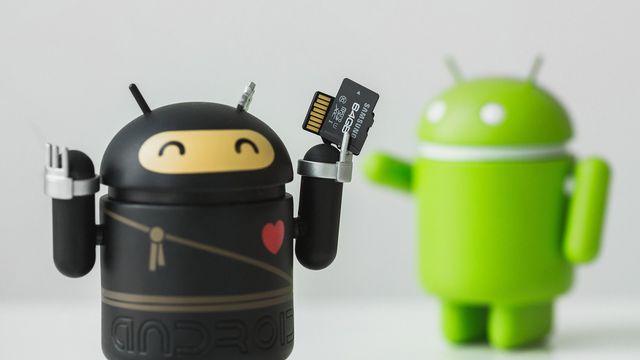
Memory cards and USB drives: when they help and when they hinder.
Not all cell phones accept cards anymore, and in those that do, it's not a perfect extension of the internal storage. It's worth considering this:
- It works well. For photos, videos, music, and documents — large files that you read occasionally.
- It malfunctions For apps and games. The card is slower than internal memory, and apps running from it take longer to open and may freeze.
- It requires attention to speed. A cheap, slow card will struggle when recording high-resolution video, resulting in interrupted recording.
- Failure without warning. The memory card is the component that most often fails in the system. Never leave the only copy of something important solely on it.
- USB drive with adapter It's used for transporting files, not for everyday storage, because the device isn't kept plugged in.
The limitations of any app that promises storage space.
A cleaning app operates within very narrow boundaries, and knowing them prevents false expectations. It doesn't expand storage—capacity is physical and comes standard from the factory. It doesn't compress your apps without loss: what some call compressing is, in practice, uninstalling while keeping the data. It doesn't recover the file you accidentally deleted in the previous scan. And it doesn't make your cloud plan last longer.
There is also a technical limitation that is almost never mentioned: in modern Android, a regular application is not allowed to freely scan and delete the cache of other applications. What remains for it is the shared file area and what the system exposes through official interfaces. Therefore, the huge number that appears on the scan screen rarely corresponds to what was actually removed from the disk.
Finally, a tip that solves more problems than any app: always keep 10% to 15% of free storage. The system needs this extra space to save updates, mount temporary files, and organize data. A device operating with nearly full storage becomes slow due to structural reasons, and no amount of spot cleaning will change that until the extra space is restored.
Common questions
My phone says 128 GB, but I only have 105 GB available. Did I run out of space?
It didn't disappear. The operating system, factory applications, and reserved recovery areas occupy a fixed portion. Furthermore, the manufacturer counts gigabytes one way and the system counts them another, which already creates a difference of a few percent. The advertised capacity is gross; the usable capacity is always less.
Is it worth deleting stickers and group audio messages?
Individually, each file is small, but the volume is what weighs on those who participate in many groups. The biggest benefit, however, comes from disabling the automatic download of videos and audios via data and Wi-Fi, because this stops the download from continuing instead of just clearing what has already been downloaded.
Is it worth transferring everything to a computer?
Yes, especially old videos that you don't want to lose or watch frequently. Just avoid keeping a single copy in one place: a computer hard drive fails just as easily as a cell phone gets lost.
What takes up more space: a thousand photos or a downloaded movie?
In general, film is preferable. Cell phone photos are compressed efficiently; video is a sequence of images per second and grows rapidly with resolution and duration. Therefore, sorting by size is much more effective than sorting by quantity.
Would recording at a lower resolution solve the problem?
It helps a lot and is the most painless change of all. Reducing the camera's resolution or frame rate cuts the size of future videos without deleting anything you already have, and the difference on the phone screen is small for everyday use.
Do I need to restart the device after freeing up space?
It's not mandatory, but it helps when the phone is very full. Restarting makes the system rebuild indexes and free up temporary areas that got stuck, and that's when the feeling of fluidity usually returns.
Overall app rating
CCleaner has over 100 million downloads and an average rating of 4.5 stars on the Google Play Store.
Users highlight its ease of use, effectiveness in cleaning up junk files, and the noticeable performance improvement after optimization.
It's a global, reliable app with an excellent market reputation. If you're looking for a practical and efficient solution to free up space on your phone, CCleaner is undoubtedly a great option.