
With the advancement of technology, more and more people are looking for fun ways to simulate what they will look like in the future. Discover your older face has become a craze on social media, thanks to applications that use artificial intelligence to generate aged versions of your face with impressive realism.
Furthermore, this trend attracts both curious people and content creators. After all, who doesn't want to take a fun test and share the results with friends? So, if you also want to join this trend, keep reading to learn about the best face aging apps currently available.
In this article, we will show 5 amazing apps that allow free download and start your virtual transformation right now. From realistic effects to funny filter options, you'll find the one that suits you best.
What is the best app to find out what your aged face will look like?
This is a common question for those who are just starting to explore these apps. After all, with so many options in stores like PlayStore, it's natural to wonder which app really delivers accurate results.
First, it is important to consider apps with good reviews and features based on artificial intelligence. Many popular apps use neural networks trained on thousands of faces to predict, with great accuracy, how human features change over time. Second, it’s best to opt for apps that allow download for free, ensuring that you can test without obligation.
So if you want discover your older face, check out our special selection of the 5 best apps of the moment below!
FaceApp
FaceApp is, without a doubt, the most famous app for facial aging. It went viral on social media precisely because it delivers realistic results with just a few clicks.
First of all, just take a selfie or choose an image from your gallery. The app applies aging filters that simulate wrinkles, gray hair, and signs of aging with extreme realism. The app also allows you to make other edits, such as changing the hairstyle, gender, and even the background of the image.
Another positive point is that the FaceApp is available for free download on PlayStore. Even with paid functions, its free version already offers great tools for those who want discover your older face in a fun and instant way.
AgingBooth
Another classic among aging apps is AgingBooth. It stands out for its simple interface and vintage effect, which gives a retro charm to its aged face.
Right after you take the photo, the app automatically applies a filter that shows you looking many years older. The result is an image that looks like it came straight out of an old movie, perfect for those who want something lighter and more relaxed.
The app is lightweight, runs well on simpler phones, and is available for free download. It's definitely a good choice for those who want to play with their appearance without any hassle.

Oldify
If you like apps with more interactive options, Oldify is ideal. In addition to allowing you to discover your oldest face, he adds animations that make his image cough, yawn or even complain of back pain — all with a lot of humor.
The app is great for creating fun and customizable content: you can adjust the aging level, choose whether you have a beard, glasses, and even accessories. You can also record videos with your older self.
Available at PlayStore, Oldify has a free and premium version, making it a smart choice for those who want to combine fun and creativity at the same time.

Make Me Old
As the name suggests, the Make Me Old specializes in aging your face. With just a few taps, you see a realistic transformation with wrinkles, spots and other details that show how you might look in the future.
One of the unique features of this app is that it allows you to add text and stickers to the final image, which makes sharing it on social media even more interesting. In addition, Make Me Old is compatible with most Android phones, which makes it easy to access.
If you want download app simple, efficient and straight to the point, this is a great option. The best part: you can free download directly from the store.

Fantastic Face
Finally, we have the Fantastic Face, which goes beyond facial aging. It offers emotional analysis, predictions about your life and even simulations of what your baby would look like. However, the most sought-after feature is still the one that allows discover your older face with great detail.
The app uses AI to identify facial features and project changes based on real aging patterns. Plus, personalized reports make the experience richer and more engaging.
With over 10 million downloads, it is one of the best rated apps in the segment. It is worth checking out. free download and be amazed by the extra features.
Features that make the difference
In addition to simply showing your older face, these apps offer extra features that enrich the experience. Some highlights include:
- Real-time filters: see the changes before you even take the photo.
- Easy sharing: integrate directly with Instagram, TikTok and WhatsApp.
- Complete facial analysis: Get insights into skin health, mood, and even personality traits.
- Offline mode: some apps work even without internet, ideal for use anywhere.
- Privacy guaranteed: Apps with good security practices keep your photos safe.
So, when choosing your favorite app, don’t forget to check out these features. With so many amazing options, it’s easy to have fun and also better understand how your appearance can change over time.
Statistical simulation, not a prediction of your face.
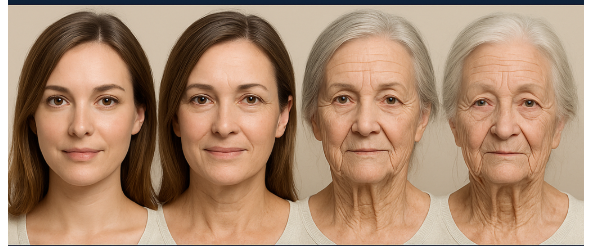
Let's make this clear before anything else: what appears on the screen is an entertainment simulation, not an image of your face thirty years from now. The app has no access to your family history, your habits, your skin type, or anything that happens to you in the next decade or so. It has a photo, and that's all.
What the program does is recognize the face in the image and apply to it the average aging pattern it has learned by observing a huge number of photographs of people of various ages. It answers a statistical question: "what does a face with these proportions usually look like after so many years?". This is different from the question you asked, which is "what will I look like?".
None of that detracts from the fun. The simulation is convincing, works well in conversations between friends, and produces good images. Just don't treat the result as information about the future, nor be alarmed by what appears—the image says more about the stock photo database used in the training than about you.
What a photo can't tell you about your future.
The factors that most influence how a face ages are simply not captured in a selfie. None of them are visible in pixels.
- GeneticsFamily history influences skin thickness, contour shape, and tendency to develop blemishes. The app doesn't know your parents.
- cumulative sun exposureIt is the environmental factor most associated with skin marks throughout life, and it depends on decades of routine, not a single moment.
- Smoking and alcoholThey alter the skin and circulation in a known way, and none of that shows up in a photo today.
- Sleep, diet, and chronic stressThey change over the years, sometimes for the better.
- Weight variationPerhaps the factor that most changes a face in adulthood, and is unpredictable by definition.
- General health and medicationInformation that even you don't have about your future.
Note that almost all of these items depend on choices and circumstances that have yet to occur. No model, however good it may be, can calculate what does not yet exist.
Why do different faces develop very similar wrinkles?
Those who test these filters on various people notice a pattern: the marks tend to appear in the same places, with the same design. The nasolabial fold extending to the corner of the mouth, crow's feet, drooping eyelids, graying hair at the temples. Two people with very different faces end up with a strange, family-like appearance.
The reason is how the model learned. By processing thousands of elderly faces, it extracted what is common to almost everyone and discarded what is individual—because what appears in a single person doesn't become the rule. The result is a kind of average aging texture applied over your facial geometry.
That's why the filter gets the overall mood right but misses the detail. It maintains the distance between your eyes, the width of your nose, the shape of your chin—the geometric parts, taken from your photo. And it fills the surface with marks borrowed from other people. You recognize yourself because the structure is yours; it feels strange because the skin isn't.
What the simulation simplifies: aging isn't just about wrinkles.
The changes that time produces on a face go far beyond lines on the skin, and filters work almost exclusively on that superficial layer. Virtually everything else is left out.
Over the years, the distribution of fat in the face changes, altering the volume of the cheeks and the definition of the contour. The position of the hairline and the density of the hair change. The teeth change, and the dental arch supports the shape of the entire face. The posture of the neck changes, which reorganizes the entire chin area. The habitual expression changes: a person who has spent decades squinting in the sun marks their face in one way, someone who has spent decades indoors marks it in another.
Furthermore, aging doesn't progress at a constant rate. It tends to concentrate in periods—a major weight change, an illness, a difficult year—and then stabilizes. The filter treats time like a uniform ruler and slides you along it. It's the simplification needed to fit into a single screen touch.
When the filter fails badly.
Some scenarios lower the quality of the result to the point of becoming a caricature:
- Child's faceThe child's face is still undergoing bone structure changes, and the model doesn't simulate growth. The result is usually a generic adult with childlike features.
- Profile picture or picture taken too tilted.Half of the reference points are estimated, and the marking is offset.
- Beard, glasses, cap or bangs covering the faceThe filter attempts to age the object along with the image, producing visible distortions.
- Dark or low-resolution photoWithout skin texture to work with, the system invents the entire surface.
- Traits that are underrepresented in trainingWhen the image bank used for learning had few faces with certain characteristics, the result was less convincing for those who had those characteristics. This is a known limitation of this type of model.
- More than one face in the image.The app might age the face incorrectly or mix information from both.
Common questions
Will the result be the same if I repeat the process with another photo?
No. Change the lighting, the angle, or the expression, and the aged face changes quite a bit. That, in itself, shows that it's not a prediction: a real prediction of your face wouldn't depend on which selfie you chose to send.
Can this simulation be used to search for a missing person?
This type of work exists, but it's done by forensic professionals, using their own methodology, family photos, and anatomical knowledge. A cell phone filter isn't suitable for this and shouldn't be used as a basis for identifying anyone.
Why does sunscreen always leave my hair white?
Because, in the set of photos he reviewed, light hair and advanced age appear together very frequently. The model is replicating statistical associations. He doesn't know that many people keep their hair color for decades, or dye their hair their entire lives.
Could seeing my aged face affect me?
Yes, it's okay, and that's normal. For some people, the joke is funny; for others, it's annoying. If the result causes distress, the wisest thing to do is delete the image and remember that it was created using borrowed logos from strangers.
Do I need to pay to see the result without a watermark?
In most cases, yes, and that's how these apps sustain themselves: free version with branding or ads, clean version by subscription.
Conclusion
In short, if you've always been curious about what your look would be like in a few decades, now you know how. discover your older face with quality and fun. Technology has made this possible with just a few clicks.
You can download now any of the recommended apps and start your journey through time. Remember that many of them are available for free on PlayStore, ready to be used by curious people of all ages.
Now it's up to you: choose your app, take the test, share the result and be amazed by the future of your own face!