
The search for precious metals, such as gold, has always been of great interest. With the advancement of technology, this activity has become more accessible and efficient. Metal detectors are essential tools for any treasure hunter, whether amateur or professional. In addition, there are several apps that help locate and identify metals and valuable objects.
In this article, we will explore the features of metal detectors, as well as present the best apps available on the market to help in this search. We will use relevant keywords to ensure better understanding and reach of the content, aiming to maximize CPM and relevance in Google AdSense.
Principais características dos detectores de metais
Modern metal detectors have evolved significantly over the years. Today, they come equipped with advanced technologies that allow for the accurate detection of precious metals such as gold. Furthermore, these devices are designed to be easy to use, making the user experience more enjoyable and efficient.
Funcionalidades dos detectores de metais modernos
Modern metal detectors offer a variety of features that make searching for precious metals easier. First, adjustable sensitivity allows the user to set the device to detect different types of metals at different depths. Additionally, metal discrimination helps filter out unwanted objects, such as nails and cans, focusing only on valuable metals.
Another important feature is the ability of some detectors to operate at different frequencies, increasing the accuracy in detecting specific objects. In addition, many devices come with interchangeable search coils, allowing customization according to the type of terrain and the objective of the search. With these features, finding gold and other precious metals becomes a more efficient and accurate task.
Aplicativos para detecção de metais e ouro
There are several apps that can help you detect metals and gold. These apps offer features that complement the use of metal detectors, making the search even more efficient.
Detector de Metais – Metal Detector
The Metal Detector app is an excellent tool for any treasure hunter. This app uses the magnetic sensors on your smartphone to detect the presence of metals. In addition, it has an intuitive interface, making it easy to use.
The Metal Detector allows for sensitivity adjustments, which is essential to avoid false positives. In addition, it displays the strength of the magnetic field in real time, providing a more accurate experience. This app is ideal for those who want to complement the use of a traditional metal detector.
Detector de Metais e Ouro
Metal and Gold Detector is another popular app among treasure hunters. It uses your smartphone’s sensors to detect metals, including gold. It also has a simple and user-friendly interface, making it easy to use for both beginners and professionals.
One of the features of this application is the ability to save the locations where metals were detected, allowing the user to return to these locations later. In addition, it offers a calibration mode that improves the accuracy of detections, making the search more efficient.
Gold Detector – Detecção de Ouro
Gold Detector is an app that specializes in gold detection. It uses your smartphone's magnetic sensors to identify the presence of gold and other valuable metals. In addition, the app has a clear and easy-to-use interface.
This app allows the user to adjust the sensitivity to detect different types of metals. In addition, it offers the option to save the GPS coordinates of the areas where gold was detected, making it easier to locate in the future. Gold Detector is ideal for those looking for a specific tool for gold detection.
Metal Detector Pro
Metal Detector Pro is an advanced app that uses your smartphone's sensors to detect metals. It offers a professional interface with several features to improve the user experience. It also allows for precise sensitivity adjustments.
One of the most useful features of Metal Detector Pro is the ability to record and save detection readings, allowing for later analysis. Additionally, it displays the magnetic field strength in real time, providing more accurate and reliable detection. This app is perfect for treasure hunters looking for an all-in-one tool.
Gold Finder – Localizador de Ouro
Gold Finder is an app dedicated to gold detection. It uses your smartphone's sensors to identify the presence of gold and other valuable metals. It also has an intuitive interface that makes it easy to use for all types of users.
This app allows the user to adjust the sensitivity to detect different types of metals and displays the magnetic field strength in real time. In addition, Gold Finder offers the option to save the GPS coordinates of the areas where gold has been detected, making the search more efficient. It is an indispensable tool for any treasure hunter focused on finding gold.
Other important features of metal detectors
In addition to the basic features mentioned above, modern metal detectors have other features that make them even more efficient and practical. Firstly, many models come equipped with LCD screens that display detailed information about the metals detected, such as type, depth and size.
Additionally, some detectors have specific detection modes for different types of terrain, such as sand, rocky soil, and water. This allows for even greater customization of the search, ensuring better results. Another useful feature is the ability of some models to operate underwater, making it easier to search in rivers, lakes, and beaches.
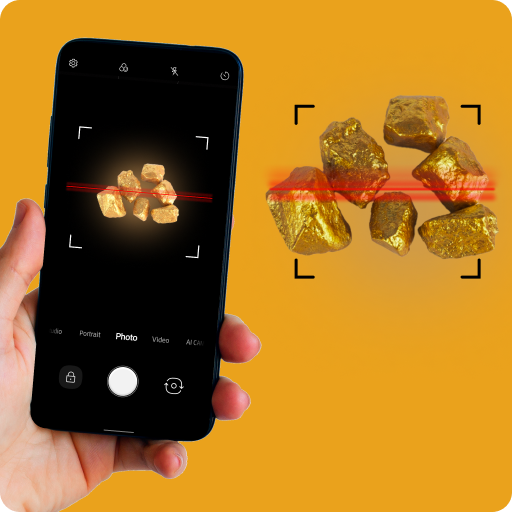
What does the cell phone sensor actually measure?
Before installing anything, it's worth understanding which part of the device is activated when an app presents itself as a detector. It's the magnetometer, The same sensor that makes a compass point north. It is passive: it emits nothing, it only measures the intensity of the surrounding magnetic field, which at the Earth's surface is in the range of tens of microteslas.
What the app displays on the screen is this reading. When an iron or steel object approaches the top of the phone, the local field distorts, the number rises, and the program sounds an alert. Move the object away, and the reading returns to normal. It's real physics, and it's honest as long as no one promises what it doesn't deliver.
The range is the first major drawback: the distortion decreases very quickly with distance. In practice, the effect is only noticeable a few centimeters from the sensor. There's also no direction factor: the application doesn't know if the object is in front, behind, above, or below—it only knows that the field of view has changed.
Add to that the ambient noise. Embedded wiring with current running through it, refrigerator motors, speaker magnets, metal door frames, and even the phone's own magnetic cover can all alter the reading. A good portion of the spectacular "finds" that appear in videos are due to this.
Why no app finds gold.
This is the part that needs to be clear, because it's the most repeated promise in the category. Gold is not ferromagnetic. Silver, copper, and aluminum aren't either. None of them distort the Earth's magnetic field in a way that a magnetometer can detect, even when placed against the sensor.
In other words: even a perfectly functioning app on a new phone with a calibrated sensor is unable to react to a nugget, a ring, or a silver coin. If the screen beeped, the explanation is different—it passed near a nail, a magnet, a steel structure, or the program simply generated an alert to keep you looking at the ad.
A true detector solves this in a way that the phone doesn't: it emits. A coil creates an alternating magnetic field; this field induces electric currents in any buried conductive metal, and these currents generate a second field that the device listens for. That's why it finds gold, silver, and copper, which conduct electricity very well, even though they are not magnetic. No cell phone has an emitting coil, and no application creates one via software.
How does a real metal detector work?
If the goal is to truly search, the right equipment is a dedicated device. Knowing the vocabulary helps prevent mistakes.
- Low-frequency induction: Most common technology in entry-level equipment. Good discrimination, suffers more in soil with high natural iron content.
- Pulse induction: It reaches greater depths and better ignores soil mineralization and salty sand, but it separates debris from good soil less effectively.
- Discrimination: The device estimates the conductivity of the target and suggests whether it is iron, aluminum, or a precious metal. It's a clue, not a diagnosis.
- Ground adjustment: Calibration for the day's terrain. Without it, the equipment beeps constantly in soil rich in iron oxide.
- Actual depth: It depends on the size of the target. An object the size of a coin is usually located a few tens of centimeters away—not meters, as the videos suggest.
- Precision tip: A small probe is used inside the already opened hole to find the part without turning everything upside down.
It's also good to adjust expectations: those who do this seriously spend most of their time digging up bottle caps, nails, wire, and lead weights. The annoying part is the work; the find is the exception.
What does Brazilian law say before you dig?
Going out with a shovel looking for treasure seems harmless, but it involves four different sets of rules. It's worth knowing them beforehand, not afterward.
- The archaeological site is protected by federal law. Excavating for prehistoric or historical material without authorization from the heritage agency is prohibited, and the find belongs to the Union. Did you find pottery, bone, stone point, or shell mound? Stop, do not remove anything, and notify the heritage agency.
- Illegal mining is a regulated activity. Extracting minerals with economic value requires authorization from the agency responsible for mining. Searching for gold in rivers or ravines on your own is not a hobby; it's illegal mining.
- The land has an owner. Private property requires written authorization from the owner. Beaches, coastal lands, and federal riverbeds are public assets with their own specific regulations.
- Conservation unit status is out of the question. In parks and reserves, digging and collecting are prohibited, even with toy detectors.
- A chance finding has civil rules. The Civil Code treats "treasure"—an ancient deposit of precious material, hidden and with no known owner—as something to be divided between whoever found it by chance and the landowner.
None of this prevents the hobby. It only prevents the irresponsible version of it, which usually ends in fines, confiscation of equipment, and the destruction of a site that cannot be recovered.
What is the app really for?
Setting aside the fantasy aspect, the program continues to have small and honest uses: finding a fallen iron key in the grass, locating a lost screw in the carpet, discovering if a part is steel or aluminum, checking if the device's magnetometer is working and calibrated, or playing with the children by hiding metallic objects in the yard.
What it doesn't do can be summed up in one sentence: it can't see inside the wall. At most, it detects a large piece of iron very close to the surface—without saying what it is, how deep it is, in which direction it runs, or if there's a water pipe or a live cable nearby, which remain invisible to the sensor. Drilling into a wall based on this reading is a gamble.
It's also worth looking at the permissions. An app like this needs exactly one sensor, and it doesn't even appear in the system's permission list. When the installation asks for camera, microphone, contacts, precise background location, and files, the product isn't the detection: it's you. This type of app usually sustains itself with full-screen ads and profile data, which explains both the request and the enthusiasm in the app store description.
Common questions
Is there an app that can find buried gold?
It doesn't exist, and it's not a matter of app quality. The phone's sensor only detects magnetic metal and at a few centimeters; gold is not magnetic. Any advertisement that promises otherwise is selling an illusion.
Why did mine beep near a golden object?
Because there was probably iron or steel involved: clasp, spring, veneered core, furniture frame. The gold color means nothing to a magnetometer.
Can you use your cell phone to find a pipe in the wall?
Not safely. PVC pipe is not metal, copper is not magnetic, and the reading does not indicate depth. To drill into a wall, the correct tool is a dedicated depth gauge, and even that requires caution.
Does the app damage the device's compass?
It won't damage it, but it can disorient you for a while if you press a strong magnet against the phone. Moving the device in a figure-eight motion recalibrates the sensor.
Are metal detectors allowed in Brazil?
Buying and using the equipment on owned or authorized land is permitted. What the law restricts is where and how to dig: archaeological sites, protected public areas, and mineral extraction have specific rules.
Is it better to rent or buy a detector?
For beginners, renting for a weekend answers the most important question — whether you enjoy the activity itself, which involves hours of hiking and a lot of unearthing trash, before spending money on equipment.
Conclusion
Searching for precious metals such as gold can be a fascinating and profitable activity. With the use of modern metal detectors and specialized apps, this task becomes even more efficient and accessible. We hope this article has provided you with useful and relevant information about the best tools and apps available for metal and gold detection.
Whether you’re a beginner or a treasure hunting pro, investing in a good metal detector and using the right apps can make all the difference. So, start your adventure now and discover the treasures that await you!