What Brazilian law allows and what constitutes a crime.
Accessing another person's conversations without their consent is a crime in Brazil: article 154-A of the Penal Code, punishable by 1 to 4 years in prison, in addition to violating the confidentiality of communications as per article 5, XII of the Constitution. Being a boyfriend, spouse, or parent of an adult does not create an exception.
And the most repeated promise in the industry is false: there is no app that can read messages from another cell phone remotely, just with the number. Those who advertise this charge a subscription without delivering, or install malware on the device of the person who requested it. Legitimate monitoring requires installation with the device in hand and covers two cases: a minor child who is aware of the monitoring, and a corporate cell phone with a signed usage policy.
Have you ever wondered where the person you agreed to share your location with at certain times of the day is? In a healthy relationship, transparency and respect go hand in hand. That's why... Life360 stands out as the ideal app for couples who want to maintain mutual trust, using modern technology to ensure security and peace of mind.
Unlike hidden or illegal apps, the Life360 is a legal 100% solution and available directly from Playstore. With it, it is possible track cell phone in real time, check the history of visited locations and even set up custom alerts. And the best part: it's easy to use, lightweight and can be free download in just a few clicks.
Advantages of Applications
Real-time location
O Life360 allows you to track where your partner is in real time. With technology GPS tracking, you see the exact location on the map and receive automatic updates as it moves.
Detailed route history
In addition to your current location, the app also stores the routes you have taken over the last few days. This allows you to know exactly the routes you have taken, the times you have taken and the length of time you have spent in each location.
Arrival and departure alerts
You can set the app to receive alerts when your spouse leaves the house, arrives at work, or enters any predefined area. A powerful feature to reinforce digital security of the couple.
Private chat in the app
O Life360 It also offers a private chat function, facilitating quick and secure communication between the couple. Everything in one place, without having to switch between other applications.
Legality and transparency
The use of Life360 It is completely legal. Unlike clandestine apps, it operates with consent and ethics, ideal for those who value true relationships with mutual control and respect for privacy.
What Makes Life360 So Popular Among Couples?
One of the biggest concerns in modern relationships is the lack of clear communication about travel. At this point, the Life360 acts as a link between technology and engagement. It eliminates guesswork and reinforces trust.
Furthermore, being a app for couples and families, its interface is friendly, simple and intuitive. Even those who have no experience with technology can use it easily. And best of all: download It's free and takes less than two minutes to set up.
1. Rastreamento em Tempo Real
This is the most used function of the Life360. The app displays your partner's location in real time with high precision. You can track their steps directly on the map and check if everything is as expected.
This function becomes even more useful in situations where there are delays, changes in routine or emergencies. Being sure that the other person is okay is a relief for any serious relationship.
In short, the Life360 offers a system of legal monitoring and practical, without invading privacy in a dishonest way.

2. Histórico de Locais Visitados
Did you know that the app stores the history of places visited in the last few days? With the Life360, you can access this history with dates, times and complete routes.
This feature is essential for those who want to understand their partner's routine clearly. Instead of arguing or being suspicious, simply open the app and check the information accurately and respectfully.
It is the type of technology that avoids unnecessary conflicts and promotes open dialogue between couples.
3. Alertas Personalizados
O Life360 allows you to set up specific alerts for certain locations. For example, you will be notified when your partner arrives home, leaves work, or visits a prearranged location.
This feature is highly effective in promoting security and peace of mind. Couples who face intense routines and different schedules can maintain their bond and attention even from a distance.
Additionally, you can receive these alerts via notification on your cell phone, ensuring discretion and agility.
4. Comunicação Instantânea
With the private chat feature, the Life360 It also acts as a communication channel. You can send quick messages, check if they have been viewed and even know the location at the time of reading.
It is a practical alternative, especially when there is a need to quickly exchange information during the day.
This detail makes the Life360 be more than a simple cell phone tracker; he becomes a real app to track with multiple uses.
5. Interface Simples e Instalação Rápida
Another highlight of the Life360 is the ease of use. The app can be easily found on Playstore. Just do the download, create an account and add the number of the person who will also accept location sharing.
That's right: the app only works if both parties consent. That's why it's the best example of family control and healthy marital relationship, with responsibility and ethics.
The application has constant updates and technical support, as well as free and premium versions with additional features.
Life360 Features at a Glance
- Real-time location on the map
- Route history of the last days
- Custom alerts by geographic area
- Private chat inside the app
- Compatible with Android and iOS
- Movement reports by user
- Emergency mode for instant alerts
- Free version with advanced features
How your cell phone finds out where you are.
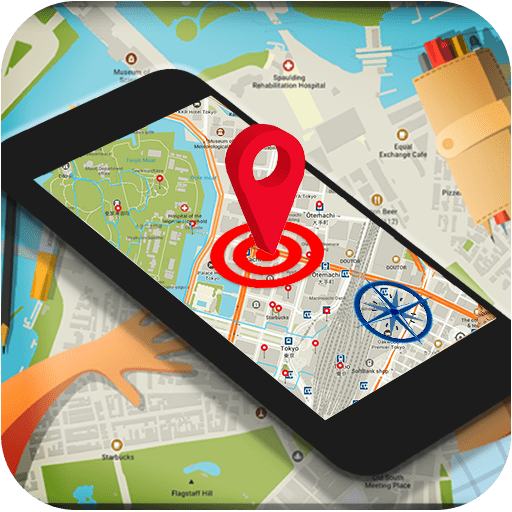
It's important to understand the mechanics, because it explains almost all the problems that arise later. No family app can see the other person's device from a distance. What exists is the opposite: each cell phone calculates its own position and sends this coordinate to the service's server, which then shows the point on the map to whoever has been granted permission. If the device on the other end is without internet, turned off, or has the app frozen in the background, no new coordinate arrives—and the map continues to display the last one it received.
This calculation combines four sources, and the weight of each one changes depending on the location:
- Navigation satellites. There are dozens of them transmitting the exact time. The device compares the delay of these signals and deduces the position with a margin of error of a few meters — provided it is looking at the sky.
- Wi-Fi networks nearby. The phone doesn't need to connect to anything: it simply needs to see neighboring networks and compare them to a database of already mapped networks. That's why location accuracy improves so much inside shopping malls, buildings, and covered parking lots, where satellite reception is poor.
- Telephone antennas. They serve as a last resort, with a margin ranging from a few hundred meters to several kilometers in rural areas. It's the remaining source of water on an empty road.
Why does the point on the map freeze or appear on the wrong street?
Before drawing any conclusions from the map, check the time of the last update. This detail resolves most misunderstandings: the point may look good and accurate, but be forty minutes old. A point without a time means nothing.
The most common causes of delay and error are these:
- Tight permission. If location data was only enabled "while using the app," it stops being sent as soon as the screen turns off. For continuous tracking, the permission needs to be permanent.
- Battery saving. Both the system's power saving mode and the aggressive optimizations of some manufacturers suspend background applications. This is the number one explanation for the location "disappearing".
- Signal reflected off a building. In areas with tall towers, the satellite signal bounces off the building facades before reaching the device, and the location jumps to the next block. It's not the app lying, it's physics.
How much battery and data does this tracking cost?
Internet data usage is negligible and often unnecessarily alarming: a coordinate is a handful of numbers, comparable to a line of text. Even sending multiple times per hour, the monthly volume is well below what a single short video consumes.
Battery life is the real cost. Keeping the location service running all day prevents the device from entering deep sleep mode, and that's what shortens the battery life. You can reduce usage without compromising the overall plan: keep only one location app active, because two competing services requesting your location double consumption without improving anything; increase the update interval, if the app allows it; and check the list of consumption per app in the battery settings to see the actual number for your device, instead of relying on promises made during installation.
What location sharing doesn't show you
This is the part that the industry's marketing department doesn't like to write, and it's what avoids internal conflict:
- It doesn't show who the person is with. The map shows an address, not the company.
- It shows no content at all. Conversations, photos, screenshots, and browsing history are beyond the reach of a location app — and, on another adult's device, beyond the reach of the law.
- It doesn't prove presence. What's on the map is the device. A borrowed, forgotten, or deliberately left device produces exactly the same point.
Where does the money for a family app come from?
A service that runs all day in your pocket, stores months of history, and keeps a server running is expensive to maintain. When it's free, the money comes in through three channels: subscriptions to unlock extra features, such as longer history and driving reports; advertising within the free version; and negotiation of commuting data with third parties, in aggregated format.
Before accepting the terms, look for the section on sharing with third parties and the retention period for your browsing history in the privacy policy. These two paragraphs state how long your daily routine map is stored and who else can view it. A leak in this type of service doesn't just expose passwords: it exposes where your family sleeps, studies, and works, along with the date and time.
How to stop sharing whenever you want
An agreement that cannot be undone is not an agreement. Closing a deal has three steps, and skipping any of them leaves a trail of conflicting information.
- Leave the group or circle within the app itself, or remove the people you share it with.
- Revoke location permission in system settings, under applications and permissions. Without this, reinstalling will bring everything back enabled.
- Delete the account on the service, not just the mobile app. Uninstalling removes the program, but the registration and history remain on the server.
Questions that arise after installation
Is the person notified every time I look at their location?
Generally, there is no notification per query, but all legitimate services make it clear that sharing is active, with an icon in the status bar or a notification within the app. An app that proposes to look without the other party knowing has changed category: it has become surveillance, and between adults that is a crime.
Is it possible to share your location without installing any app?
Yes, it works. The maps that come pre-installed on Android and iPhone share your location with a contact for a set period of time—an hour, all day, or until you turn it off. For the most common use, which is to let someone know you arrived safely, this solves the problem without needing to create a new account or save your location history.
Does activating airplane mode disable tracking?
Yes, and the device is also switched off. In either case, the map freezes at the last received position and continues displaying that point, which deceives those who don't check the time. Disappearance on the map is almost always due to a dead battery or poor signal, not escape.
Can I install it on my partner's phone without telling them?
No. Installing anything on another adult's device without their knowledge is computer intrusion, and generic verbal consent does not protect the person who installed it. The way to go is to ask and listen to the response: monitoring that only exists because one party doesn't know is the problem, not the solution.
Conclusion
Maintaining a healthy relationship requires effort, dialogue and transparency. Life360 It is the ideal tool for couples who want to eliminate mistrust, communicate better and maintain their bond even in the midst of the hustle and bustle of everyday life.
With powerful features like GPS tracking, location alerts and detailed history, the app is consolidated as the most efficient and ethical on the market. And the best part: you can free download right now and start using it in just a few minutes.
Avoid surprises, improve communication and take care of your relationship with the ones you love. Try Life360 and discover how technology can be an ally of trust.