Who visited your profile: why no app can show it.
Start here: no social network tells you who visited your profile. Instagram, Facebook, TikTok, and X don't provide this data, neither to their own users nor to third-party apps. Any app that promises this list is making up names—usually people who already interact with you—and many ask for your password, which gives your account away to the scammer.
Curiosity is legitimate and the demand is enormous: millions of people search every month for "who viewed my profile." Precisely for this reason, it's one of the most exploited areas by fake apps in the app store. Below is what's real, what's fabricated, and what you can find out without revealing your account information to anyone.
Por que esse dado não existe
A third-party application can only see what the social network provides through its official programming interface, the API. Profile visits have never been on that list—not in the paid version, not for professional accounts, not for agencies. It's not a difficult permission to obtain: it's information that the platform doesn't provide to anyone.
There's a business reason behind this. Social networks depend on people browsing freely. The day people realize their visits are recorded with their name and time, they'll look at fewer profiles—and that's exactly what the platforms don't want.
The only real exception is LinkedIn., which has the official "who viewed your profile" feature. It works because the logic there is professional and the network assumes this behavior — and even so, those who browse in anonymous mode appear only as unidentified visitors.
Como esses aplicativos fabricam a lista
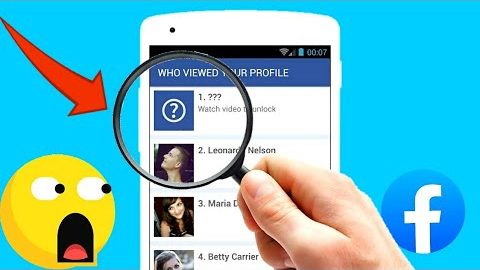
The trick is simple and works because it seems plausible. The app takes those who already appear publicly connected to you—recent followers, likes, comments, those who appeared in your suggestions—shuffles them, draws names randomly, and presents them as "visitors." When you recognize a name, you conclude that the app got it right. In practice, it showed you someone who was already there all along.
Some go even further and ask you to log in with a username and password on a screen that mimics that of the social network. Then the damage is real: the credentials go to the server of whoever published the app, the account is used to send spam or scams involving "loans between friends," and recovery is usually difficult.
Another option charges a weekly subscription to "unlock the names." You pay, the same scrambled list appears, and the charge repeats until someone cancels in the store.
Sinais de que o app está inventando
- It asks for the social network password. Outside of the official app. Legitimate login happens within the platform's own app or through a browser on its domain.
- It promises a list of visitors from Instagram, Facebook, or TikTok. This data does not leave the platform.
- It shows "visits" even before you connect your account. There was nowhere to get the money from.
- Displays exact percentages. This number indicates someone's "interest" or "obsession" with you. It's a randomly generated number.
- Charges a weekly subscription. right at the beginning, before showing anything.
- Description full of translation errors. and a developer without any other serious published applications.
O que dá para saber de verdade
The information is real and it comes directly from the platforms themselves, for free, without any intermediary app:
- Who saw your story?. On Instagram and Facebook, the list of story views is official and personalized, available for 24 hours. It's the closest thing to the data people are looking for.
- Who interacted. Likes, comments, shares, and saves appear to you and say a lot about who follows your content.
- Professional account metrics. When you switch to a business or creator account, Instagram releases reach, accounts reached, age range, and peak audience activity times. These are aggregated numbers, without names — and that's how it works for large profiles as well.
- Who unfollowed me?. You can compare the list of followers over time. It's not a visit, it's something else, but it's usually what the person really wants to find out.
- LinkedIn. There, the feature is official and is in your own profile, without needing to install anything.
Já instalei um desses. E agora?
- Change your password from the social network immediately, and also from the email linked to it.
- Enable two-step verification., which prevents access even if the password is in someone else's hands.
- Revoke access for third-party applications. In the platform's security settings, remove anything you don't recognize.
- Check the active sessions. and close any that are on a device or in a city that you don't recognize.
- Cancel your subscription. Uninstalling the app on the Play Store or App Store will not stop billing.
- Uninstall And, if necessary, report the app to the store.
Perguntas frequentes
Even paying doesn't allow you to see it? Not even by paying. There is no plan from Instagram, Facebook, or TikTok that unlocks visitor lists, because that data is not offered.
If someone doesn't follow my account, can they still see my profile? If the profile is public, yes, and you won't know. A private profile solves the problem: only those you approve will see the posts.
Does the order of the "best friends" list or suggestions indicate who is looking at me? No. This order comes from interaction — likes, comments, messages — and not from profile visits.
I saw my name on a friend's guest list. How? You probably interact with it, and the app specifically chose who interacts with it. That's the mechanism that gives the impression of accuracy.
Conclusão
If an app offers a list of who visited your profile, the only safe conclusion is that it's making it up — and the risk of giving away your password is much higher than the chance of finding out anything.
What truly exists is already on the networks themselves: the list of who viewed the story, the interactions, and, for those who want numbers, the metrics of the professional account. It's less than the advertising promises, and it's all that can really be known.