Nowadays, technology has revolutionized many aspects of our daily lives, and dog training is no exception. More and more pet owners are looking for ways to improve their dog's education in a practical, efficient, and affordable way. In this sense, training apps are an excellent solution. These apps allow you to train your dog at home, with expert tips and guidance at your fingertips.
Furthermore, the use of dog apps not only makes the training process easier but also ensures a more interactive experience adapted to your pet's needs. In this article, you will find a selection of the five best training apps currently available. If your goal is to provide the best for your dog, these dog training apps are perfect for you!
Melhores Aplicativos para Adestramento de Cães
Training your dog may seem like a difficult task, but with the help of best apps for training dogs, the process becomes much simpler. These applications offer a series of features ranging from tips on online dog training to complete training tutorials. Below, we’ve listed the five best training apps so you can choose the best option for your dog.
1. Puppr
Puppr is one of the training apps most popular on the market, known for its user-friendly and easy-to-use interface. This app offers training lessons divided into levels, from basic to advanced. This way, you can monitor your dog's progress according to his skills.
In addition to interactive lessons, Puppr features a professional trainer who guides pet owners in real time. This makes the app ideal for those who want a digital dog training more personalized and efficient. If you are looking for a complete app for your dog, Puppr is an excellent choice.
2. Dogo
The Dogo is another standout among the dog apps, focused on helping both owners and dogs make the most of their training time. The app offers a variety of commands and tricks that can be taught in a practical and fun way.
One of Dogo’s most interesting features is its use of a camera to monitor your pet’s progress. Through this technology, you can send videos of your dog in action and receive feedback directly from professional trainers. This ensures a more interactive and optimized experience, placing Dogo among the best training apps available.
3. GoodPup
GoodPup is one of the most recommended apps for anyone who wants to make a online dog training with personalized support. Through weekly video calls with a professional trainer, the app allows you to have detailed and exclusive monitoring for your dog.
Another advantage of GoodPup is that it is suitable for both puppies and adult dogs, making it an excellent option for those looking for long-term training. If you are looking for dog training tools With personalized support, GoodPup is sure to meet your expectations.
4. PetSafe
PetSafe is an application aimed at those looking for more technological solutions in pet training. It offers smart devices that connect to the app, helping to control behaviors such as excessive barking and anxiety.
This one training app offers a range of programs aimed at different types of behavior, making it ideal for those with dogs with specific needs. PetSafe's innovative technology and diverse features make it stand out among the best apps for training dogs.
5. Dog Trainer
Dog Trainer is a complete platform for digital dog training. With it, you can access a series of videos and detailed tutorials that teach everything from the simplest commands to advanced training techniques.
Additionally, the app allows you to set goals and training schedules for your dog, offering an organized experience that is tailored to your pet's pace. If you're looking for an app with practical tips and a wide range of features, Dog Trainer is an excellent choice among the best. training apps.
Funcionalidades e Vantagens dos Aplicativos de Adestramento
Now that you know the best training apps available, it is important to highlight some of the main features offered by these apps. In addition to teaching basic and advanced commands, they offer a series of interactive tools, such as video tutorials and the use of technologies, such as sensors and cameras, to monitor your dog's behavior.
Another advantage is the practicality of being able to carry out a online dog training from home, without the need to hire an in-person trainer. This allows owners to save time and money, while still ensuring quality training for their pets. dog apps They also provide greater flexibility, allowing training to be done at the owner's own pace.
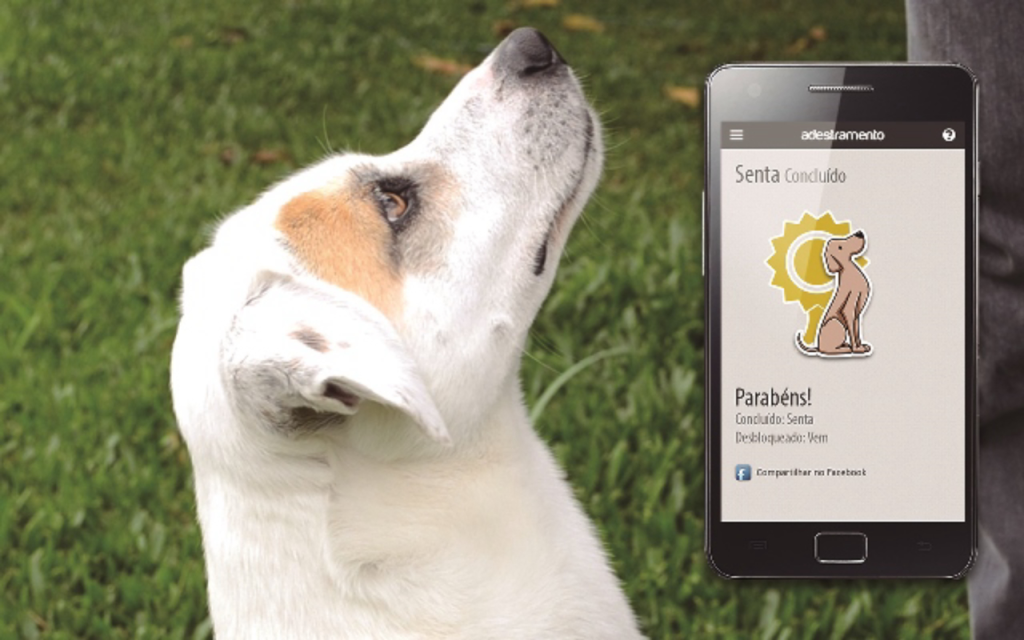
What happens in a dog's head when it learns?
Every serious workout app relies on the same principle: behavior that yields positive results tends to repeat itself. It seems obvious, but the detail that determines the outcome is the... time. The dog associates the reward with what it did in the previous instant, within a window of one to two seconds. If the treat comes five seconds after the "sit," you haven't rewarded the sitting action: you've rewarded what it was doing five seconds later, which is usually standing up.
The marker exists to resolve this delay — the click of a clicker or a short, always identical word, like "that's it." The marker is triggered at the exact millisecond of the correct action and alerts the dog that the reward is on its way. Before using it for any command, it needs to be "charged": click and give the treat, about twenty times, without asking for anything in return, until the sound gains meaning on its own.
The second useful concept is... successive approximation. Complex behavior doesn't appear ready-made. You reward the initial, basic behavior first—the dog that looks at the bed, then the one that takes a step towards it, then the one that touches it with a paw—and gradually increase the difficulty. A good app shows this ladder; a superficial app only shows the final step and leaves you stuck when the dog doesn't get it right the first time.
How to set up a home workout session
- Short and frequent. Three to five minutes, two or three times a day, yields better results than half an hour straight. A tired dog makes mistakes, and making too many mistakes discourages both of you.
- Before the meal. A dog that has just eaten is not interested in any treats.
- Small snack. About the size of a grain of corn, soft, for quick swallowing. Large size hinders digestion and disrupts the rhythm.
- Easy environment first. Start in a quiet room, away from other people and animals. The noisy street and yard come later, once the control is firmly established.
- One word per command. Choose a command, let the whole household know, and don't change it. "Sit," "sit," and "sit there" are three different commands for a dog.
- Finish by getting it right. End the session right after a good replay, even if you feel like trying another one. The last memory of the session is the one that sticks.
The order that usually works
- Pay attention to the name. Before any trick, the dog needs to stop and look when you call him. Without that, no other command will work.
- Marker loaded, as described above.
- Sit down. It is the easiest to mold and serves as a basis for requesting calm in any situation.
- Here. Always greet the dog with a celebratory welcome, and never use it to call the dog for something he dislikes, such as a bath or the end of a walk. A call that ends in something unpleasant ceases to be effective.
- He is. Increase one variable at a time: first time, then distance, and only then distraction. Increasing all three at once is a classic recipe for failure.
- Let go and release. These are the controls that prevent accidents involving food on the floor, spilled medicine, and dangerous objects.
- Loose guide. The walk is the most difficult exercise, because the street competes with you in smell and movement. Leave it for last.
- Generalization. A command learned in the classroom is not effective on the sidewalk until it has been practiced there. Repeat each command in at least three different locations.
What an app can't solve
Here's the limitation that no subscription plan overcomes: the software doesn't see your dog. It delivers a generic script, and generic scripts work for teaching tricks and routines, not for treating behavioral problems.
- Aggression and biting These issues cannot be resolved via video call. Growling, lunging, and disputes over food or objects require an in-person assessment for the safety of everyone in the house.
- Separation anxiety — destruction, howling, and urinating only when left alone — it's suffering, not stubbornness. The protocol is lengthy, individualized, and done with supervision.
- Intense fear Fireworks, thunder, or street noise require well-conducted desensitization. Forcing exposure makes it worse, and the app has no way of knowing that it has worsened.
- Sudden change Behavioral issues in adult dogs are a matter for veterinarians before they are for training. Pain, thyroid problems, vision or hearing loss, and neurological issues can be presented as symptoms such as "he's become rebellious.".
- Peeing in the wrong place It could be a urinary tract infection. Training a sick dog is pointless.
A word about the equipment that appears linked to these apps. Shock collars, spray jets, and ultrasound emitters don't teach any behavior: they interrupt what's happening. The dog may stop barking and still have the same fear that made it bark—only now with an added shock associated with the trigger. Putting all this into a pretty app doesn't change the mechanism. For barking, anxiety, and fear, the only sustainable approach is understanding the cause, and that's the work of people.
How much does it cost to train using your cell phone?
The most common model is freemium: some lessons are free, the rest are available through a monthly or annual subscription. When there is human support—a video with a trainer's commentary or a weekly call—the price goes up considerably, because then you're paying for a professional's time, not just software.
Two things to consider before subscribing. The first is time: basic obedience is built over weeks of daily practice, and a subscription that's not being used doesn't train a dog. The second is data consumption: training apps are video-based, and video is large files. Half an hour of good quality lessons consumes several hundred megabytes of data. Download the lessons over Wi-Fi and free up space after watching—this prevents your phone from filling up in the middle of a training session when you need the camera to record your dog.
It's also worth comparing this to the in-person alternative. A consultation with a trainer or a veterinarian specializing in behavior can resolve in one visit what months of generic videos can't achieve, precisely because someone is looking at your dog, in your home, within your routine.
Common questions
At what age can I start training?
Puppies learn from their first weeks at home, with very short sessions and playtime. What requires care is exposure to the outdoors before completing their vaccination schedule—coordinate with your veterinarian where and when to socialize them.
Can an older dog still learn new commands?
Learn. Change the pace: shorter sessions, less repetition at a time, and pay attention to joint pain, which causes the dog to avoid sitting or lying down. If he resists a specific position, suspect discomfort before suspecting a tantrum.
My dog only obeys when he sees the treat. What should I do?
This happens when the treat becomes a clue instead of a consequence. Take the food from your hand, make the gesture with your empty hand, and reward after the correct action by taking the treat from your pocket. Then, start rewarding intermittently.
Is it possible to train a dog on your own, without any professional help?
Basic obedience and good manners at home, yes, with consistency. Anything involving fear, aggression, or the risk of being bitten is not the domain of a self-taught individual.
Does recording your dog on video really help?
It helps a lot, and it's the best part of using your phone during training. You notice your own timing errors, unintentionally repeated gestures, and commands spoken twice—things that go unnoticed in the moment.
How long until the command becomes reliable?
A simple command appears in a few days; building reliability with distraction takes weeks of repetition in different places. Anyone who promises an obedient dog in three days is selling, not teaching.
Conclusion
In short, the best apps for training dogs mentioned in this article are great options for those who want to train their dog in an efficient and fun way. Whether you are an experienced owner or someone who is just starting out in the world of pet training, these training apps offer a variety of features that make the process simpler and more interactive.
By choosing one of these apps, you will be investing not only in your dog’s well-being, but also in a practical and economical solution for training. So, choose the app that best suits your needs and start transforming your relationship with your pet today!